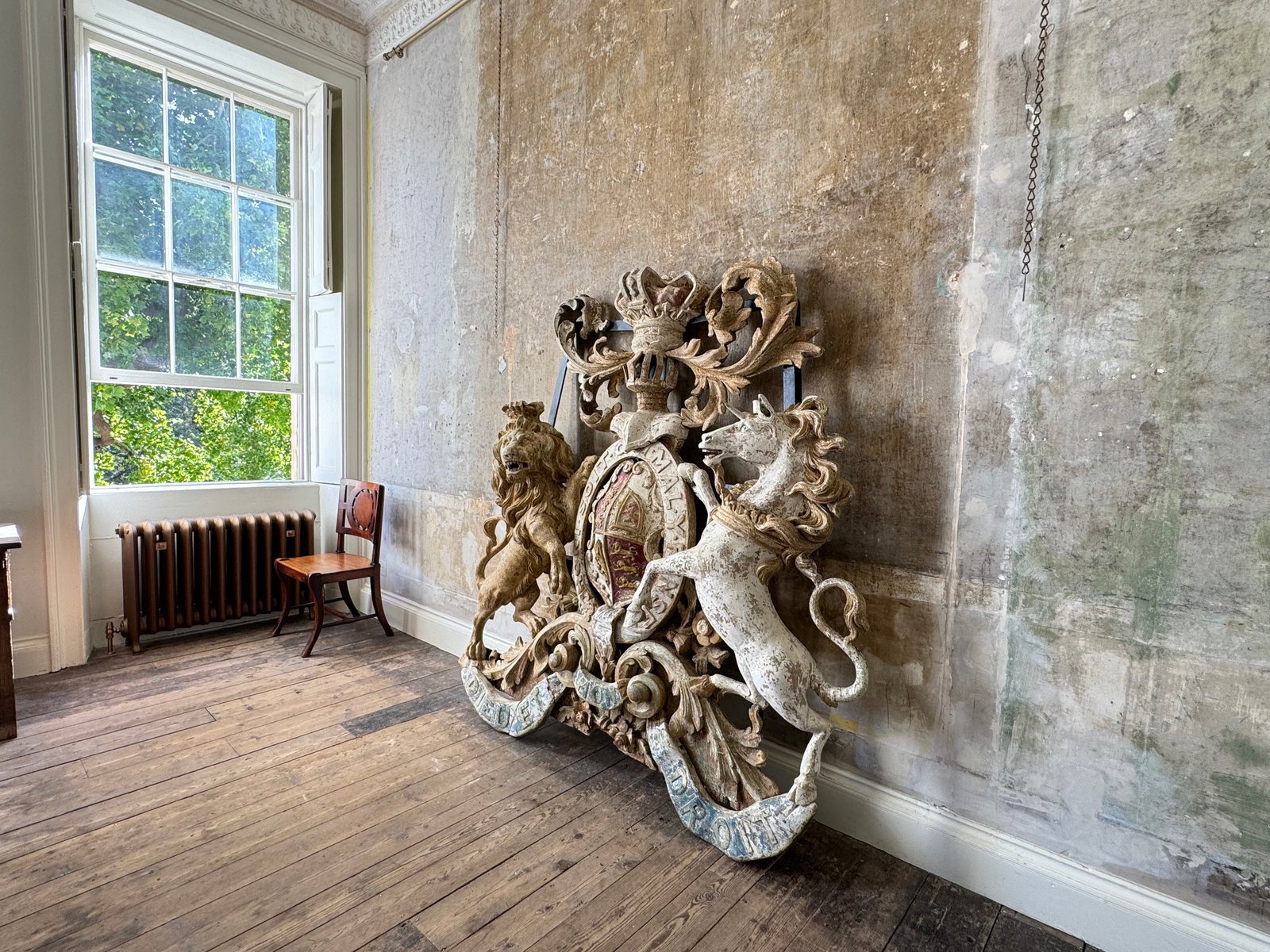
A large 19th-century coat of arms or Royal Warrant, carved in pine and limewood with gilt and polychrome decoration.
The central shield is distinctly divided into four quarters. This configuration was adopted when Queen Victoria ascended to the throne in 1837. Prior to 1837 the shield included an inescutcheon representing the Kingdom of Hanover. A woman could not inherit the Hanoverian throne under Salic law, so the Hanoverian insignia was permanently dropped when Victoria became Queen, leaving the configuration seen here.
The choice of softwoods indicates this warrant was destined for a prestigious indoor architectural space. Similar warrants were sited in courtrooms, council chambers and wealthy commercial houses carrying the Royal Warrant.
The rear of the carving has early, irregular hand-worked iron strapping and directly indicates mid-19th-century workshop assembly techniques. This has been added to in the mid 20th century with an L section steel framework which can be seen towards the top of the piece.
This extremely rare piece has been gently taken back to the remnants of the original parcel gilt and polychrome painted decoration; it is structurally in outstanding original condition.
Provenance: Private collection, Wiltshire, England.
English, circa 1845.
Height 71in (180cm).
Width 71in (180cm)
Depth 12.75in (32.5cm).